Maison of hand zardozi · Kolkata
Gold, sewn by hand.
Couture-grade zardozi for boutiques and fashion houses. Your design, embroidered in our own Kolkata atelier by karigars who have spent more than thirty years at the frame.
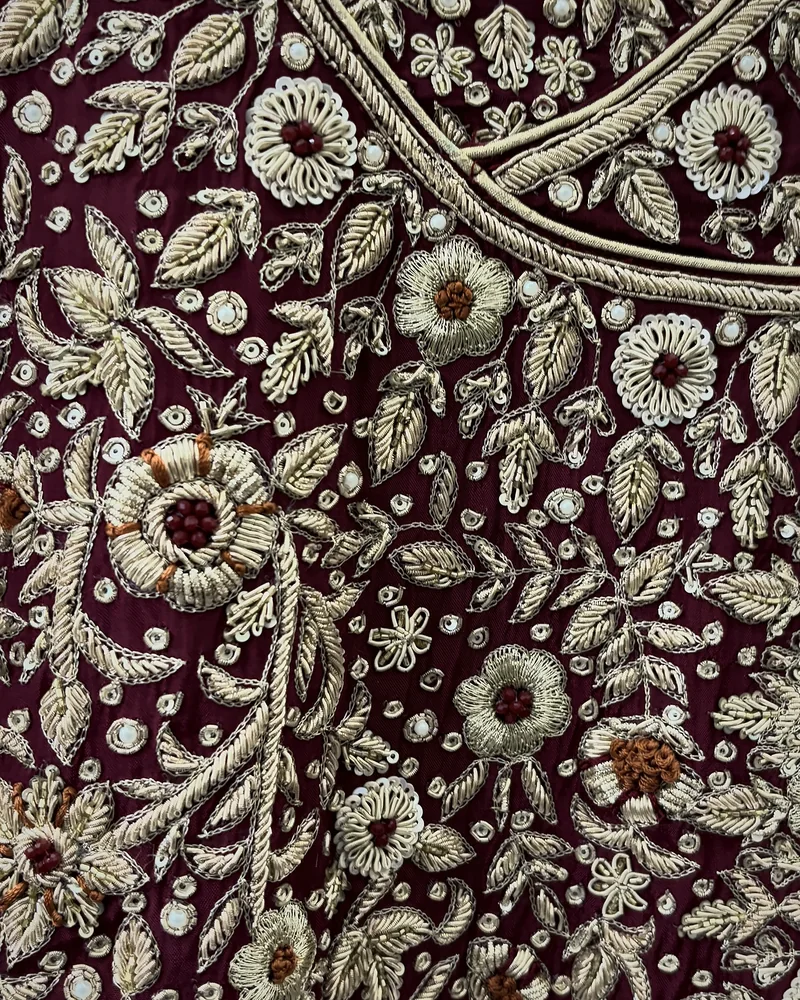
From the adda.
A selection of pieces embroidered in our atelier: bridal yokes, kurta panels, borders and necklines, in every colour and on every ground. Select any image to see it closer.
Your design. Our adda. Your label.
We take orders from boutiques, designers and fashion houses, and embroider them in our own atelier with our own karigars, to the quality you state. You keep the design and the name. We deliver the handwork.
Briefed once, sampled once, then embroidered exactly to the approved sample, piece after piece.
- 01Brief
Send your artwork or reference, the fabric, the zari grade, quantity and delivery date.
- 02Sample & quote
We embroider a sample of your design and share a clear, itemised quote.
- 03Approve
Your approved sample becomes the master reference for every piece.
- 04Embroider
Our in-house karigars work the order, with progress shared along the way.
- 05Check & deliver
Each piece passes our quality checks, then is packed and dispatched.
Why houses work with us
Start a briefEvery master karigar has more than thirty years at the adda. That shows in the tension, the density and the finish.
Couture-standard stitching, clean reverse sides and true lines, in real, tested or metallic zari.
Our own karigars, our own atelier and no chain of middlemen, so the price you pay goes into the work.
Fast sampling and dependable timelines, planned around your collection calendar and delivery dates.
One point of contact from brief to dispatch, with regular updates and photographs as the work progresses.
From a single bridal commission to production runs across a season, with teams working frames in parallel.
Every piece is checked against your approved sample before it leaves. See our checks.
Your artwork is used for your order only. The work carries your label, never ours.
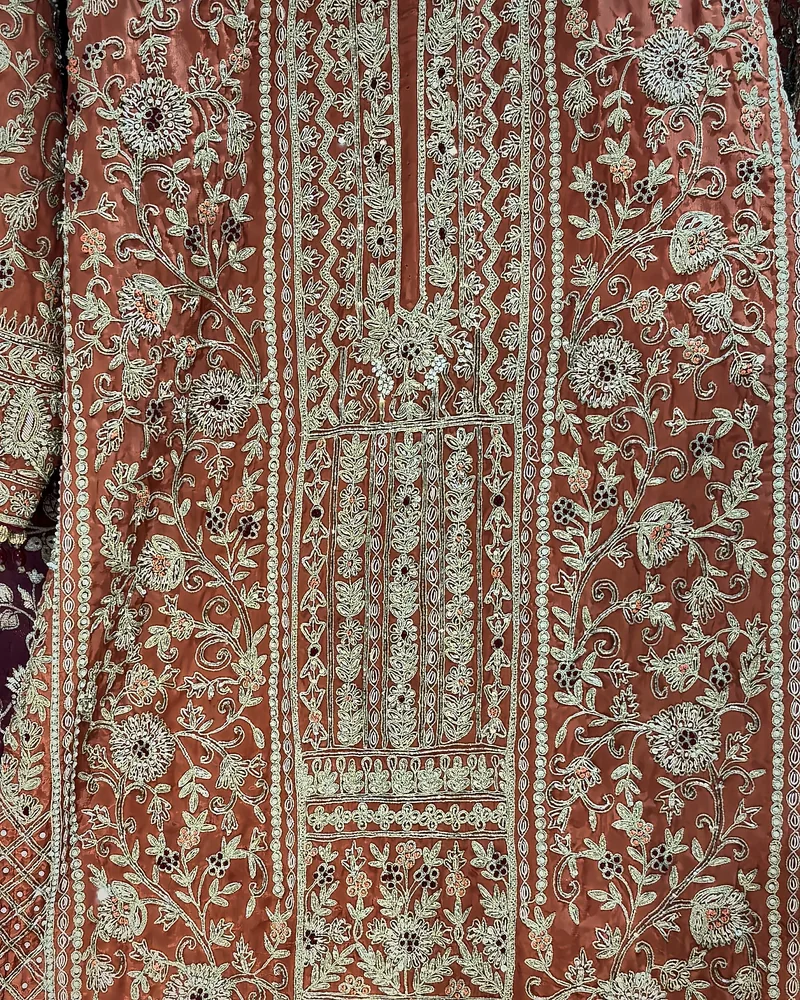
Kurta front on rust, worked from placket to hem.
What we embroider
For every part of a collection.
- Bridal lehengas & kalidarJaal, buta, heavy kinari
- Kurtas, anarkalis & yokesNecklines, panels, sleeves
- Sarees & dupattasBorders, pallus, butti fields
- MenswearSherwanis, bandhgalas, stoles
- Couture & western silhouettesPlacement panels, appliqué motifs
- Patches, crests & insigniaMonograms, badges, trims
The Artisans of Kolkata
Thirty years at the frame.
Zardozi is learned at the adda, the wooden frame over which cloth is stretched taut. A karigar begins by threading sequins and cutting dabka to length, and is trusted with an outline only after years beside a master.
Many of our karigars come from families who have done this work for generations, in the lanes of Kolkata and the villages of Howrah across the river. They sit around one frame, each hand taking a part of the design, so a single panel moves from tracing to finish without leaving the room.
- Adda
- The wooden frame on which the fabric is stretched for work.
- Aari
- A hooked needle that draws thread up from below the fabric and locks it in a chain on top.
- Khaka
- The design drawn on paper and pricked with fine holes, through which it is transferred to the cloth.
- Karigar
- The craftsman. A master is called ustad.
Quality Assurance
Checked five times before it leaves.
Your approved sample is the standard. Every piece is held against it at each stage, so the hundredth matches the first.
- Tracing
The khaka is checked against your artwork for scale, placement and symmetry before a stitch is made.
- Materials
Zari grade, sequin size, bead and stone colours are matched to the approved sample, lot by lot.
- On the frame
A master karigar reviews density, tension and line at the adda while the work is still in progress.
- Finishing
Reverse sides cleaned, loose ends secured, chalk and tracing marks removed, shape and drape checked.
- Final inspection
Each piece is compared with the master sample, measured, and only then packed and dispatched.
Heritage
Five centuries of gold on cloth.
Zarbaaf takes its name from the Persian for weaving in gold.
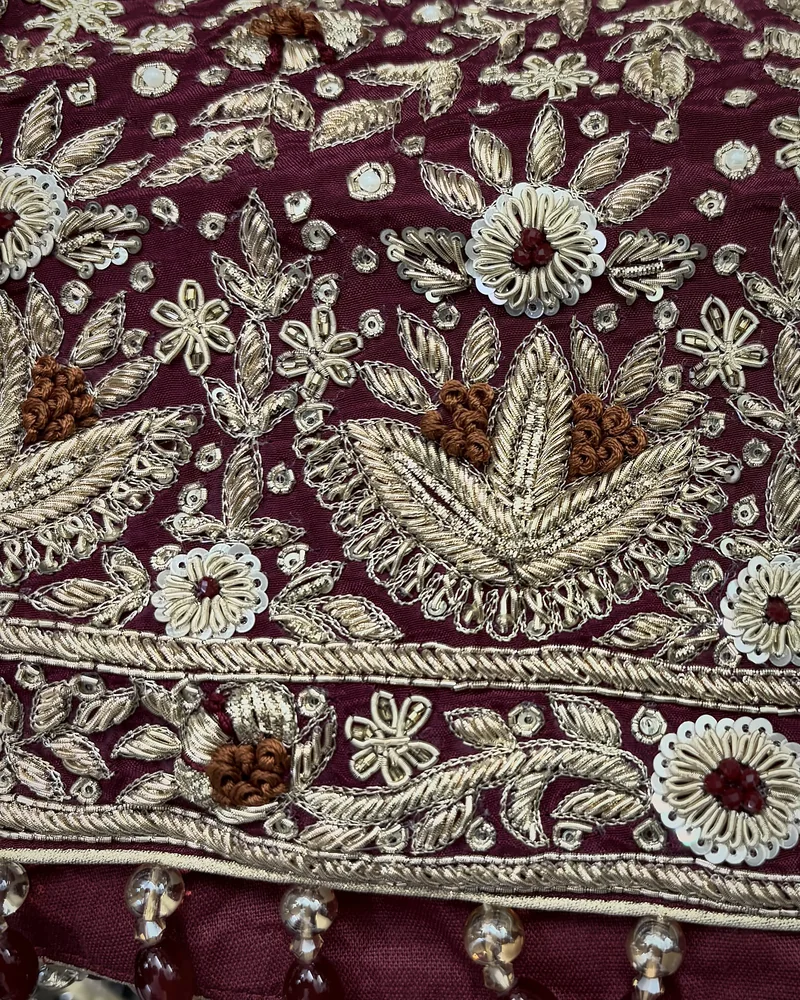
Zari is the metal thread and wire. Zardozi is the embroidery made with it: coiled wire, couched thread, sequins, pearls and stones built up by hand into raised, sculpted ornament that catches the light from every angle. No machine reproduces its depth.
-
1500sThe Mughal karkhanas
An art of the court
Zardozi came to India from the Persian tradition and flourished at the Mughal court. Under Emperor Akbar, royal workshops embroidered robes, turbans, tent hangings, scabbards and elephant trappings in gold and silver wire. Owning it signalled wealth, rank and favour.
-
1618A gift between empires
A robe for the Shah
Emperor Jahangir commissioned a robe of gold and silver zardozi, set with precious stones, as a gift for Shah Abbas of Iran. The piece was so extravagant that some at court thought it excessive.
-
Late 1600sThe scattering
From the court to the cities
As imperial patronage thinned under Aurangzeb, and further as the empire declined, karigars carried the craft to new patrons. Lucknow, Bhopal, Hyderabad and other centres each grew their own school of gold embroidery.
-
1856Awadh comes to Calcutta
A miniature Lucknow on the Hooghly
When the British annexed Awadh in 1856, Wajid Ali Shah, its last Nawab and a celebrated patron of Lucknow's zardozi, came to Calcutta and settled in exile at Metiabruz, on the city's southern edge. He lived there until his death in 1887 and rebuilt it as a miniature Lucknow, bringing the court culture of Awadh to Bengal.
-
1947After independence
Revival
The loss of royal patrons and the arrival of industrial textiles had pushed the craft to the margins. After independence it revived, using copper-based zari, sequins and beads alongside the older materials, and found its way back into bridal and couture wardrobes.
-
TodayBengal's hands
One of India's great embroidery belts
The districts around Kolkata hold some of India's largest communities of zari karigars. The Panchla block of Howrah alone is home to more than 50,000 zari artisans, and Bengal's karigars stitch for ateliers in Mumbai, Delhi and Surat. Zarbaaf works from the heart of this tradition.
Zari, the thread
Three grades. You choose, we match.
The grade of zari sets the look, weight and price of a piece. We work in all three, to the standard stated in your brief. Sequins, beads and stones are matched to the same standard.
Fine silver, electroplated with gold. Rich, soft and long-lived. For bridal and collector pieces.
Copper wire electroplated with silver, then gold. The look of real zari at a working price, widely used in couture today.
Metallised polyester film. Light, bright and resistant to tarnish. Suited to prêt lines and high volumes.
The vocabulary of zardozi.
Every piece is built from a small set of techniques and a classic set of layouts. Use these names in your brief, combine them freely, and we will sample the combination for you.
Techniques
Technique swatches are drawn to show how each element is built. Select any one for its uses and pairings, or to enquire.
Motifs & placements
How the work is laid out on the garment. Photographed from our atelier.
Enquire
Begin with a brief.
Tell us about the piece or the collection. We reply with questions, a sampling plan and a quote.